
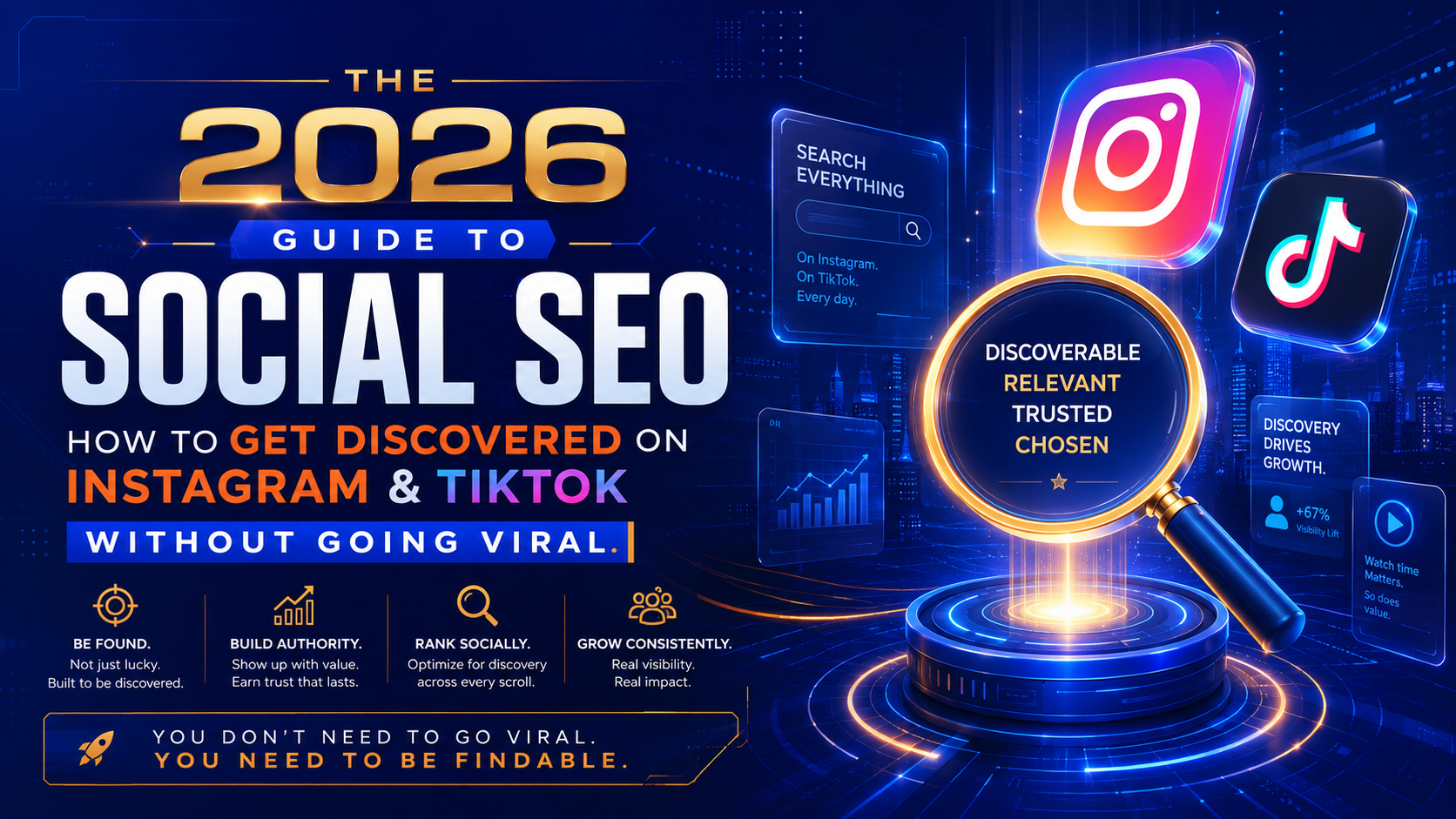
The 2026 Guide to Social SEO: How to Get Discovered on Instagram & TikTok Without Going Viral
Virality is unpredictable. Discovery doesn't have to be. In 2026, Instagram and TikTok have evolved into sophisticated search engines — and the businesses and creators who understand Social SEO are the ones getting found, followed, and trusted. This comprehensive guide breaks down exactly how to optimise your social presence for discoverability, from keyword strategy and content architecture to algorithm intelligence and the future of AI-driven search — no viral moment required.
SOCIAL MEDIA MANAGEMENT
PD Graphics MU
5/28/202611 min read
Introduction: The Search Revolution Nobody Told You About
There is a quiet but seismic shift happening in the way people find information, discover businesses, and make purchasing decisions — and it's not happening on Google.
It's happening on Instagram. It's happening on TikTok. And if your business isn't optimised for it, you are actively invisible to an entire generation of potential customers.
According to a widely cited internal study from Google, nearly 40% of Gen Z users now turn to TikTok or Instagram as their first port of call when searching for recommendations — whether that's a restaurant in their city, a skincare product that actually works, or a freelance designer for their next project. For the 25–38 age demographic — the millennials and elder Gen Z cohort who are simultaneously building businesses, making household purchasing decisions, and consuming short-form content at record rates — social platforms have become the new search engines.
This is Social SEO. And in 2026, it is no longer a niche tactic reserved for full-time content creators. It is a fundamental business strategy.
The best part? You don't need to go viral to benefit from it.
This guide is designed specifically for small and medium-sized businesses, sole proprietors, startup founders, and individuals preparing to launch their first venture. By the end of this article, you will have a thorough, actionable understanding of how Social SEO works, why it matters in 2026, and precisely how to implement it — platform by platform, strategy by strategy.
Chapter 1: Understanding Social SEO — What It Is and Why It's Different
Before diving into tactics, it's essential to establish a clear conceptual foundation. Social SEO refers to the practice of optimising your social media content — its language, structure, metadata, and engagement signals — so that it surfaces organically when users conduct searches within social platforms.
Traditional SEO (Search Engine Optimisation) is built around Google's indexing and ranking algorithms. Social SEO operates on a fundamentally different but increasingly parallel principle: it leverages the native search functionality within Instagram and TikTok, both of which have invested enormous resources into making their platforms searchable, intelligent, and contextually aware.
How Instagram Search Works in 2026
Instagram's search algorithm has matured considerably. It now analyses:
Keywords in captions, bios, and alt text — Instagram's OCR (Optical Character Recognition) and NLP (Natural Language Processing) capabilities mean the platform actively reads and indexes the text within your posts.
Hashtag relevance and specificity — Generic hashtags (#love, #business) have diminishing returns. Niche, intent-driven hashtags carry significantly more indexing weight.
Account authority and niche consistency — Instagram rewards accounts that consistently produce content within a defined niche. Topic coherence signals expertise to the algorithm.
Engagement velocity and quality — How quickly a post accumulates saves, shares, and comments — and from whom — directly influences its search ranking.
Location data — For local businesses, geotagging remains one of the most underutilised yet powerful Social SEO tools available.
How TikTok Search Works in 2026
TikTok's search engine has arguably outpaced Instagram's in sophistication. Its algorithm integrates:
Spoken keywords — TikTok's AI actively transcribes audio and indexes the words you say in your videos. If you verbally mention "affordable branding services in Mauritius," that phrase becomes searchable metadata.
On-screen text and captions — Text overlays within videos are read, indexed, and weighted.
Video descriptions and hashtags — Much like Instagram, keyword-rich descriptions expand your content's search surface area.
User behaviour signals — Watch time, replays, shares, and profile visits following a search query all inform TikTok's ranking of your content for future similar searches.
TikTok's native keyword suggestion tool — The search bar's autocomplete feature is a goldmine of real user search intent data — and most businesses aren't using it.
Chapter 2: Keyword Research for Social Platforms — The Foundation of Everything
If traditional SEO taught us anything, it's that keyword research is the bedrock of discoverability. Social SEO is no different — the methodology simply shifts slightly in execution.
Where to Find Social Keywords
On TikTok: Open the app and begin typing your niche or service into the search bar. The autocomplete suggestions that appear represent actual search queries entered by real users. These are not algorithmically invented phrases — they are live intelligence from your target audience's behaviour. Write them down. Build content around them.
Real-world example: A freelance graphic designer in their late twenties searching for clients might type "graphic design" into TikTok's search bar and discover that users are actively searching "graphic design tips for beginners," "how to price graphic design services," and "graphic design portfolio ideas 2026." Each of these is a content opportunity.
On Instagram: Use the Explore search bar similarly. Search your niche and observe the auto-populated suggestions, related tags, and the content types that appear at the top of results. The accounts consistently appearing in those results have cracked Instagram's Social SEO — study their captions, hashtag strategy, and content structure forensically.
Google Trends and AnswerThePublic: While technically traditional SEO tools, both platforms surface question-based queries that translate seamlessly into social content briefs. If people are asking Google "how to start a small business with no money," they are almost certainly asking the same question on TikTok.
Keyword Placement Strategy
Once you've identified your target keywords, placement is everything:
Instagram Bio: Your bio is indexed. Include one or two primary keywords that define your niche (e.g., "Brand Designer | Small Business Marketing | Mauritius").
First line of captions: Algorithms — and human attention spans — prioritise the opening sentence. Lead with your keyword naturally.
Alt text on images: Instagram allows you to manually write alt text for every post. Most accounts leave this blank. Filling it with keyword-rich, descriptive text is an immediate competitive advantage.
TikTok video descriptions: Write these as mini-blog entries. Two to three sentences incorporating natural keyword language, not forced stuffing.
Spoken words in video: For TikTok particularly, verbally stating your primary keyword within the first five seconds of a video dramatically improves its indexing potential.
Chapter 3: Content Architecture — Building for Search, Not Just Scroll
In 2026, the most discoverable content is not necessarily the most entertaining content. It is the most relevant and structured content. Understanding how to architect your posts for maximum search exposure is what separates the businesses that grow sustainably from those perpetually chasing trends.
The AISA Framework for Social SEO Content
Think of every piece of social content through the lens of four interconnected objectives:
A — Answer a specific question. Every post should address a concrete query. "What is the difference between a logo and a brand identity?" is infinitely more searchable than "Check out our new design work." Specificity drives search traffic.
I — Integrate keywords naturally. Keyword integration must feel organic, not mechanical. Write the way your audience speaks, but be deliberate about the language you choose. The goal is conversational fluency with strategic precision.
S — Stimulate meaningful engagement. Comments, saves, and shares are not just vanity metrics — they are ranking signals. Posts that generate substantive conversation ("What's your biggest branding challenge?") signal topical authority to the algorithm.
A — Anchor with consistent niche positioning. Posting about branding one week, recipes the next, and travel the week after will confuse the algorithm and fragment your audience. Algorithms reward accounts that are reliably, consistently about something specific.
Content Formats That Perform Best for Social SEO
Carousel posts on Instagram consistently generate higher save rates than single images, and saves are one of the most powerful ranking signals the platform recognises. Educational carousels — "5 Things Your Logo Must Communicate" or "The 3-Step Brand Strategy Framework" — perform exceptionally well in search because they answer questions comprehensively.
TikTok "Search-bait" videos — short, informative videos structured around a specific searchable question — are the fastest-growing content category on the platform. A 45-second video titled "How to Choose a Brand Colour Palette" that actually delivers on its promise will accumulate search traffic for months after posting.
Instagram Reels with keyword-rich hooks — The opening three seconds of a Reel are critical for both human retention and algorithmic indexing. A hook like "If you're a small business owner struggling with brand consistency, watch this" is simultaneously keyword-rich and emotionally targeted.
Chapter 4: The Role of Hashtags in 2026 — Evolution, Not Extinction
The great hashtag debate has raged for years. Are they still relevant? Do they still work? In 2026, the answer is nuanced but clear: hashtags remain valuable, but their function has evolved from reach tools to classification signals.
Platforms now use hashtags primarily to categorise content rather than distribute it. This means the strategy of using thirty maximum-volume hashtags indiscriminately is not only ineffective — it can actively dilute your content's topical clarity.
The 2026 Hashtag Framework
Tiered specificity: Use a combination of three hashtag tiers — broad niche tags (e.g., #SmallBusinessMarketing), mid-range specific tags (e.g., #BrandingForStartups), and hyper-localised or ultra-niche tags (e.g., #MauritiusBusiness or #LogoDesignMauritius). This tiered approach ensures your content is classified accurately and surfaces for both wide and narrow search intents.
Quality over quantity: Between five and fifteen highly relevant hashtags consistently outperform thirty generic ones. Each hashtag should feel like a deliberate content category, not a scatter-gun approach.
Hashtags as keywords: Think of every hashtag as a keyword. If you wouldn't use the phrase in your caption, you probably shouldn't use it as a hashtag. Alignment between caption keywords and hashtag keywords reinforces your content's topical signal to the algorithm.
Chapter 5: Local Social SEO — The Untapped Goldmine for SMEs
For small and medium-sized businesses operating in specific geographic markets — whether you're a boutique brand agency in Mauritius, a freelance photographer in Port Louis, or a startup café in Ebène — local Social SEO is arguably the highest-return strategy available to you.
Geotagging and Location-Based Discoverability
Every Instagram post, Story, and Reel you publish without a geotag is a missed local discovery opportunity. Location tags function as local search filters — when a user in Mauritius searches for "graphic design" on Instagram, accounts and posts tagged in Mauritius carry a significant ranking advantage over untagged competitors.
Practical action: Geotag every single post, Story, and Reel to your most relevant location — your city, your business district, or a recognisable local landmark. The cumulative effect of consistent location tagging compounds over time into meaningful local search dominance.
Local Keywords in Bio and Captions
Incorporating location-specific language into your bio and captions serves a dual purpose: it enhances local Social SEO and it immediately signals relevance to your local audience. Phrases like "Brand Design Agency | Mauritius," "Digital Marketing for Mauritian Businesses," or "Helping SMEs Across Mauritius Build Powerful Brands" are simultaneously keyword-rich and geographically targeted.
Chapter 6: Analytics, Iteration, and the Data-Driven Social SEO Mindset
Strategy without measurement is speculation. In 2026, both Instagram and TikTok provide increasingly sophisticated native analytics that allow you to understand precisely how users are finding your content — and that data is invaluable for iterative Social SEO improvement.
Key Metrics to Monitor
Instagram Insights — "Discovery" data: Instagram now provides detailed information on how many accounts discovered your content through search versus hashtags versus the Explore page. Monitoring this data week-over-week reveals which content formats and keyword strategies are driving the most organic search traffic.
TikTok Analytics — "Traffic Source" breakdown: TikTok's analytics dashboard shows you exactly what percentage of your views came from search. If a particular video is receiving disproportionate search traffic, that is a content template to replicate and scale.
Keyword ranking monitoring: While social platforms don't yet offer native keyword ranking tools comparable to Google Search Console, manually testing your target keywords in the search bar monthly — and noting where your content appears in results — provides directional intelligence for refinement.
The Iteration Cycle
Social SEO is not a set-and-forget strategy. It demands a consistent cycle of publish, measure, analyse, and refine. The businesses that compound their discoverability over time are those that treat every post as both a piece of content and a data point — learning from what surfaces organically and doubling down with intentionality.
Chapter 7: Future Trends in Social SEO — What's Coming and How to Prepare
Understanding where Social SEO is heading is just as important as mastering where it stands today. The landscape is evolving rapidly, and the businesses that anticipate these shifts will hold a formidable first-mover advantage.
AI-Powered Semantic Search
Both Instagram and TikTok are investing heavily in semantic search capabilities — the ability to understand meaning and intent behind a query, not just its literal keywords. This means future search algorithms will surface content based on conceptual relevance, not just exact keyword matches. For content creators, this signals a shift toward depth, nuance, and topical expertise over keyword density.
Prepare now: Write captions and video scripts that explore topics comprehensively. Provide context, examples, and layered explanations. The richer the semantic landscape of your content, the more surfaces it will be indexed against.
Social Search Ads and Paid Discovery
TikTok has already begun testing search result advertisements — sponsored content appearing directly within search results for specific queries. Instagram is anticipated to follow suit at scale. This creates an entirely new paid discovery channel that mirrors Google Search Ads but operates within the native social experience.
Prepare now: Begin building familiarity with your platform's advertising infrastructure. Businesses already comfortable with social ad targeting will be well-positioned to leverage search ads as the format matures.
Voice and Visual Search Integration
As augmented reality features expand on both platforms, visual search — the ability to search using an image rather than a text query — will become increasingly prominent. Similarly, voice-activated search within social apps is an emerging behaviour, particularly among mobile-native users.
Prepare now: Ensure your visual branding is distinct and consistent so that visual search algorithms can identify and index your brand assets accurately. Invest in high-quality imagery that is both aesthetically compelling and semantically descriptive through alt text.
The Rise of "Answer-First" Content
Mirroring the AI-generated answer overviews emerging in traditional search, social platforms are beginning to surface content that directly and immediately answers a user's search query — foregrounding the most concise, accurate, and credibly signalled responses. Content that buries its core value proposition under unnecessary preamble will increasingly lose ground to content that leads with the answer.
Prepare now: Adopt a "headline-first" content architecture. State the answer, insight, or value proposition in the first sentence — of your caption, your video hook, your carousel headline. Treat every piece of content as if the algorithm might only surface the first ten words.
Chapter 8: A 30-Day Social SEO Action Plan for Small Businesses
Theory without execution is decoration. Here is a practical, structured 30-day action plan to launch your Social SEO strategy immediately.
Week 1 — Audit and Research: Conduct a full audit of your existing profiles. Optimise your bio with primary keywords and location tags. Perform keyword research using platform search bars and document 20 target search phrases relevant to your niche.
Week 2 — Content Restructuring: Rewrite your next five captions using the AISA framework. Implement the tiered hashtag strategy. Add alt text to your last ten Instagram posts. Begin verbally stating your primary keyword in the opening seconds of every TikTok video.
Week 3 — Volume and Consistency: Publish at minimum five pieces of keyword-optimised content across both platforms. Prioritise educational carousels on Instagram and "search-bait" videos on TikTok. Geotag every single post.
Week 4 — Measure and Refine: Review your analytics dashboards. Identify which pieces of content generated the highest search-driven discovery. Document the patterns — content format, keyword, posting time — and build your next month's content strategy around those learnings.
Conclusion: Discoverability is a Strategy, Not an Accident
The narrative that social media success requires a viral moment is one of the most pervasive and damaging myths in modern digital marketing. The businesses building durable, profitable online presences in 2026 are not waiting for lightning to strike — they are engineering their discoverability with intention, intelligence, and consistency.
Social SEO is the methodology that makes this possible. It is patient, strategic, and compounding. A well-optimised post published today may drive organic search traffic six months from now. A keyword-rich bio written this week may be the reason a potential client finds you next quarter.
You do not need to go viral. You need to be findable — by the right people, at the right moment, with the right message.
Start today. Optimise one profile. Research five keywords. Rewrite one caption. The compounding effect of small, consistent, intentional actions is precisely what separates the businesses that grow from the ones that simply post.
At PD Graphics, we specialise in helping small and medium businesses, startups, and sole proprietors build powerful, discoverable digital presences across social media platforms. From Social SEO strategy and content creation to brand identity, website development, and full-scale digital marketing — we bring the expertise, creativity, and strategic depth your business deserves.
Whether you're starting from zero or scaling an existing presence, our team is ready to help you get found, get followed, and get results.
📞 Call or WhatsApp: +230 5742 7786 🌐 Visit: www.pdgraphicsmu.com | info@pdgraphicsmu.com